“More Than a Stepping Stone: The Unique Freedom, Risk, and Beauty of Chapbooks.”
Among Seattle 2023 national conference events, this panel was very well reviewed and well attended. Moreover, the participating artists enjoyed working together and learning from eachother.
Panelists: Summer Farah, Stalina Villarreal, Priscilla Wathington, Nandi Comer and Aliah Lavonne Jahan-Tigh who proposed the panel.
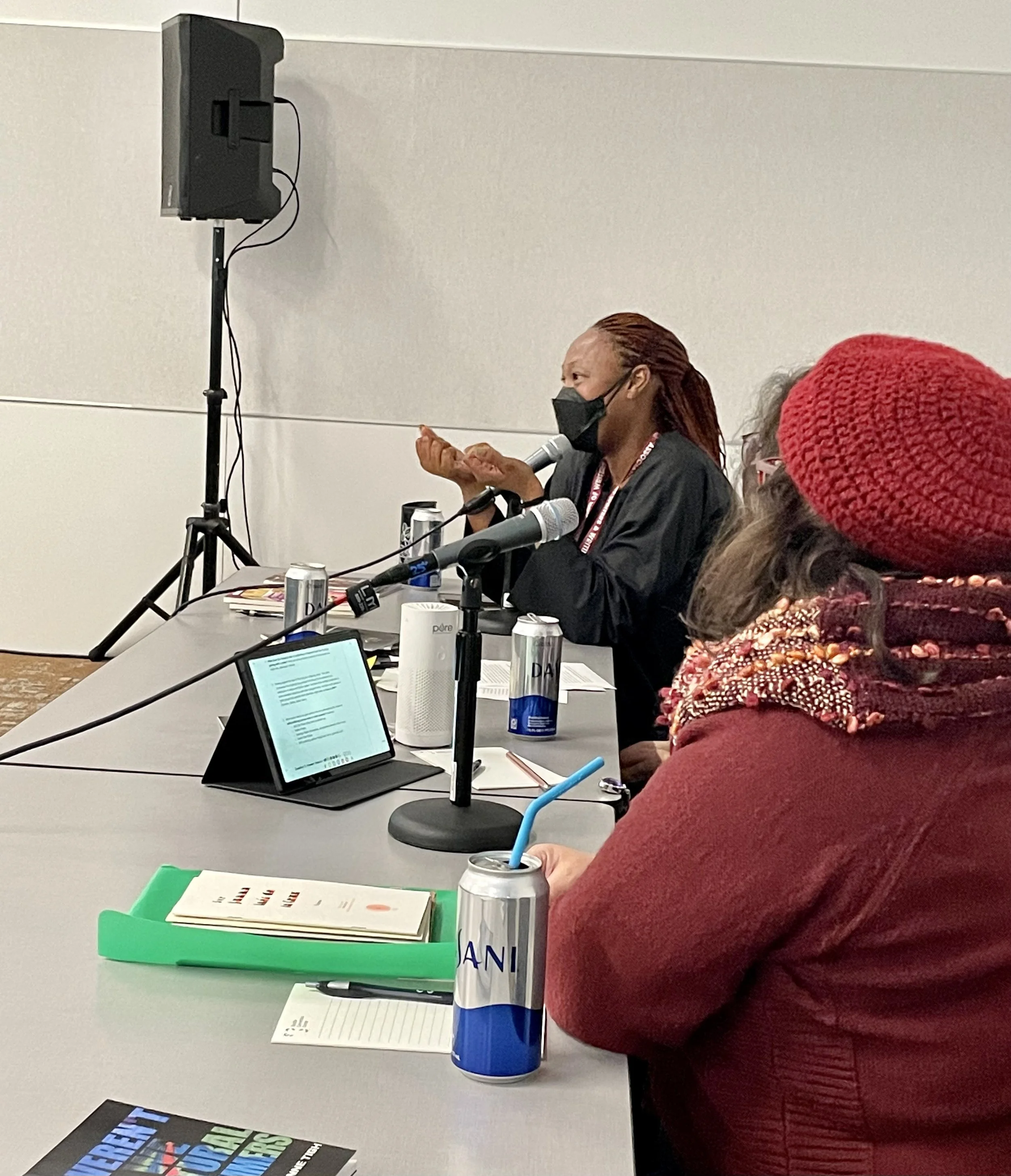
Here, poet and multi-media artist Nandi Comer (black jacket) is speaking about her collection of various chapbooks. Fellow panelist and similarly multi-talented, Stalina Villarreal(red sweater) sits in the foreground of the picture.
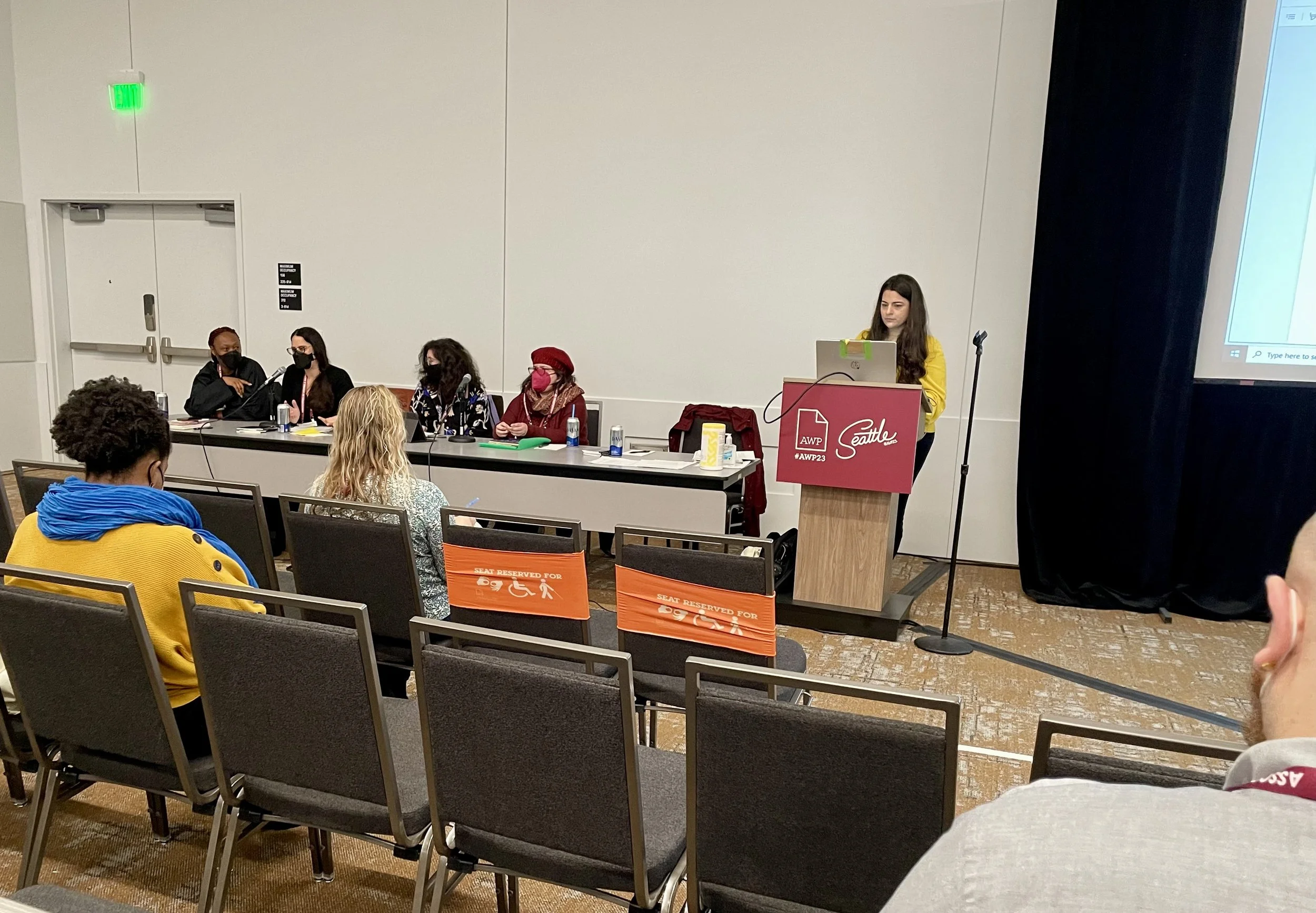
Aliah Lavonne Jahan-Tigh (yellow top, standing) welcoming attendees. In the picture at the speakers’ table, starting right to left: Stalina Villarreal(red top), Summer Farah (black and white print scarf), Priscilla Wathington(black top), and Nandi Comer(black top) seated next to her.
This panel was in March 2023 in Seattle. Speakers sometimes unmasked when speaking, but panalists asked, in the posted outline, that attendees mask to reduce risk of COVID spread.
Participant Opening Remarks
Aliah Lavonne Tigh: I relate to the chapbook as a freedom-giving form. For example, artist Liz Williams asked for work from Queer Southerners and created a zine of poems and visual art, Shapes and Angles of a Creative Queerantine. This work is accessible here. I am also thinking about the economic ability gifted to the artist when they are able to produce a work themselves and sell it.
Nandi Comer: I am most drawn to the subversive history of the chapbook—the form offering space for voices of resistance and experimentation. Chapbooks are punk whether they are handmade manually stapled pamphlet-like collections or the art driven book. It has also been an outlet for independent media producers interested in honoring new voices and work that takes risks that mainstream publishing typically avoids. For these reasons, I approach the chapbook remembering it as a medium for work that maybe doesn’t fit in other book forms. (I will show images of some of my personal collection.)
Summer Farah: I'm interested in the subversive histories of the chapbook as well! There is such a beautiful freedom that comes with an object that is both tangible and real but also doesn't "count" in so many ways - a chapbook can have an ISBN or it might not. A chapbook might disappear into your bookshelf or it might have a spine. It might be part of a larger project or exist perfectly on its own. Everyone has a loose understanding of the timing of a chapbook and what it means, and I want to poke around in those places. Where does a chapbook begin and a zine end? What about a collection?
Stalina Villarreal: The chapbooks I have produced are works of translation, brief works, or translations that had the intentional purpose to be shortened. These works often take playful forms like accordion-spined chapbooks.
Priscilla Wathington: I am interested in discussing how the chapbook operates as a liminal creature, between the formal and informal. As such, there is an inherent political possibility to this medium, because it has the ability to slip borders. In its shape, it is a small, passable object that can easily fit into a pocket. Chapbooks are also financially nimble and so can offer the economic opportunity of publication without the pressure of a "wide audience." As a result, they can open up the possibility of greater artist experimentation, risk-taking, and resistance.
Panelist Bios:
Nandi Comer is the author of the chapbook, American Family: A Syndrome (Finishing Line Press) and Tapping Out (Triquarterly), which was awarded the 2020 Society of Midland Authors Award and the 2020 Julie Suk Award. Her poems have appeared in Crab Orchard Review, Green Mountains Review, and Southern Indiana Review.
Summer Farah is a Palestinian American poet, editor, and critic. She is the author of I could die today & live again, forthcoming from GameOverBooks.
Dr. Stalina Emmanuelle Villarreal is a poet, translator, and essayist whose book Watcha is forthcoming from Deep Vellum Publishing. She has published translations of poetry by Sor Juana Inés de la Cruz, Minerva Reynosa, Maricela Guerrero, and Sergio Pérez Torres.
Priscilla Wathington is a Palestinian American writer and editor. Her chapbook, Paper and Stick (Tram Editions), draws from her human rights work. Her poems have appeared in Gulf Coast, Michigan Quarterly Review and elsewhere. She sits on the board of RAWI and is a MFA candidate at Warren Wilson College.
Moderator and Proposer: Aliah Lavonne Tigh is the author of Weren’t We Natural Swimmers, a chapbook with Tram Editions, and with poems appearing in Academy of American Poets’ Poem-A-Day, Guernica, The Texas Review, Matter Monthly, The Rupture, and others. Tigh lives in Houston, Texas.
Aliah, Stalina, Priscilla, and Farah reunited at the Mizna and RAWI table, but the lovely Nandi Comer wasn’t in the bookfair at the same time.